Skip to content


Latest update August 2026
Very often we hear that it’s hard to find vegetarian food in Korea. Indeed, when talking about Korean dishes, three main elements generally come to mind immediately: rice, spiciness and meat. Because of this last, almost ubiquitous, ingredient, many vegetarians and vegans are rightly worried about spending a long period of time in Korea, fearing that they cannot avoid eating meat and will be forced to include it in their diet. Well, this is not the case! Of course, while meat and fish dishes make up the vast majority of Korean dishes, there are also many dishes suitable for vegetarians.
Our recommendations of vegetarian food in Korea
Among the various vegetarian food options you can find in Korea, here are some of our recommendations!

Yachae Bibimbap (야채 비빔밥)
Bibimbap is one of the most distinctive dishes in Korean cuisine and one of the best vegetarian food in Korea. There are various versions, depending on the city where it is eaten. Most often it contains meat (bulgogi bibimbap, 불고기 비빔밥), but the version with vegetables only (야채, yachae) and possibly egg, is also one of the most popular and widely eaten. Bibimbap is a rice dish covered with various ingredients arranged by type to create a harmony of colours. Vegetables usually include mushrooms, soya bean sprouts, kimchi, carrots and courgettes. It can also be accompanied by hot sauce or soy sauce.
Yachae Gimbap (야채 김밥)
Gimbap is also a traditional Korean dish and there are various versions. It is a roll of seaweed and rice in the centre of which various fillings can be found. The most common types of gimbap are those stuffed with meat and vegetables, tuna and vegetables, or just vegetables. Some also tend to put egg and/or cheese. So if you are vegan, remember to ask the restaurant not to put the latter two ingredients just in case.

Japchae (잡채)
Japchae is another popular vegetarian food in Korea. It is sweet potato starch noodles cooked in a pan with vegetables and seasoned with soy sauce, sesame oil and pepper. There is also a version with meat, but the most common type is the one without meat. It is often served in small quantities together with other banchan (반찬, the side dishes included in the service), but it can also be ordered as a main dish.
Kimchi jeon (김치전)
Jeon are Korean pancakes with vegetables, meat or fish. They are often eaten on rainy days accompanied by makgeolli (막걸리, Korean rice wine). The two most common versions of jeon are seafood jeon (haemul pajeon, 해물 파전), and kimchi jeon (kimchi-jeon, 김치전), which is a vegetarian food in Korea. While the dishes mentioned can be vegetarian (of course, if you make the appropriate requests), jeon contains egg right in the batter, so a vegan version is not possible.
Sundubu jjigae (순두부 찌개)
Sundubu jjigae is a very spicy soup with soft tofu (sundubu) served in a boiling stone bowl. Although it is technically not a dish with animal ingredients, many restaurants tend to use meat broth to prepare it. We therefore recommend always asking for confirmation before ordering.

Kongnamul gukbap (콩나물 국밥)
Kongnamul gukbap is a soup made of soybean sprouts and rice. It is a spicy dish typical of Korean home cooking and, among other things, is considered a cure-all for recovering from a hangover.
Siraegi guk (시래기국)
Siraegi guk is a soup of dried horseradish leaves (siraegi) cooked with soybean paste. This is also a spicy dish because it contains chili powder.
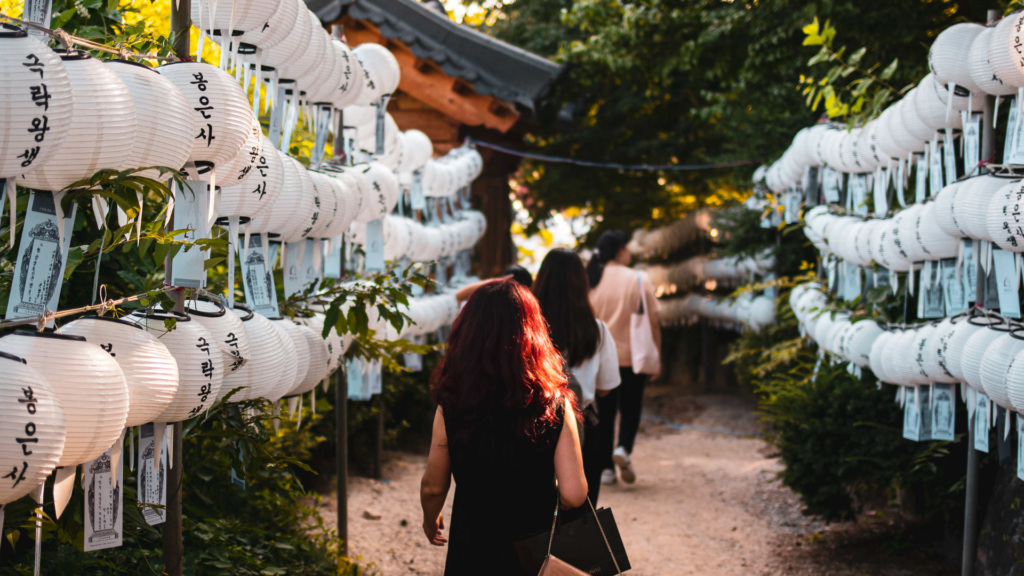
Korean temple food (사찰음식)
If you are looking for vegetarian or vegan-friendly Korean food, Korean temple food is one of the best options to explore.
Traditional Korean temple food does not use meat or seafood and focuses on vegetables, mushrooms, grains and fermented ingredients. It also traditionally avoids the five pungent vegetables known as oshinchae: garlic, green onions, chives, wild chives and Chinese squill.
Temple food is no longer limited to Buddhist temples. There are now restaurants and programs where visitors can experience Korean temple cuisine, making it a great option for vegetarians and vegans who want to try authentic Korean food.
For example, Balwoo Gongyang near Jogyesa Temple in Seoul offers traditional temple cuisine, while restaurants such as Sanchon in Insadong specialize in vegetarian-friendly temple food.
Want a more immersive experience? Discover 4 popular temple stays in Korea!
Other vegetarian dishes
Those mentioned above are just some of the dishes we recommend as vegetarian food in Korea. In fact, there are many more, such as yachae juk (야채 죽 Korean vegetable porridge), tteokbokki (떡볶이 Korean rice cakes, usually spicy), gyeran jjim (계란 찜 steamed egg). Even though it may be a different cuisine from what you are used to, there is no lack of vegetarian variations, so you don’t have to worry about that!
Tips for vegetarians and vegans in Korea
One of the biggest challenges for vegetarians in Korea is that dishes may contain animal-based ingredients that are not immediately obvious. Meat and seafood broths, fish sauce, and fermented seafood can be used even in dishes that appear to consist mainly of vegetables.
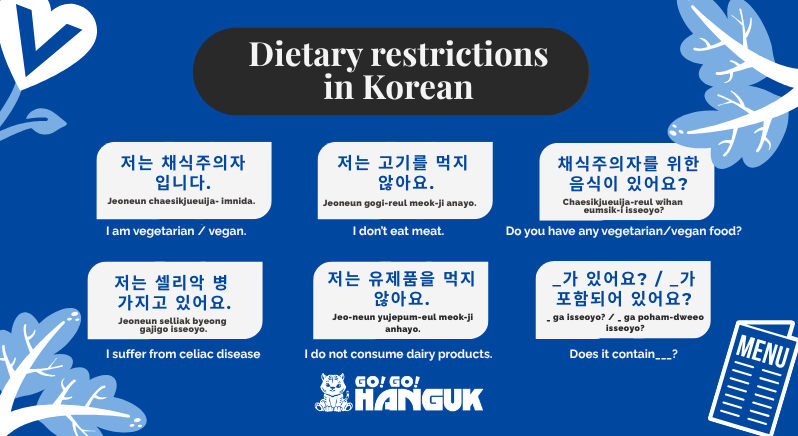
If you are vegetarian or vegan, clearly explain your dietary requirements when ordering. It can also be helpful to have a Korean phrase ready on your phone to show restaurant staff.
Useful phrases for asking about vegetarian food in Korea
These are some phrases you can use in a restaurant to explain that you don’t eat animal by-products or to ask if the food you are about to order contains any.
- 저는 채식주의자입니다.
Jeo-neun chaesikjueuija-imnida.
I am a vegetarian. - 저는 고기를 먹지 않아요.
Jeo-neun gogi-reul meok-ji anhayo.
I don’t eat meat. - 저는 유제품을 먹지 않아요.
Jeo-neun yujepum-eul meok-ji anhayo.
I do not consume dairy products. - 채식주의자를 위한 음식이 있어요?
Chaesikjueuija-reul wihan eumsik-i isseoyo?
Do you have vegetarian food? - ___가 있어요? / ___ 가 포함되어 있어요?
___ ga isseoyo? / ___ ga poham-dweeo isseoyo?
Does it contain ___? / Does it contain ___?
We hope you find this article on vegetarian food in Korea useful.
For more information on Korean language and culture, follow the Go! Go! Hanguk blog and do not hesitate to contact us about living and studying in Korea.