Skip to content


Have you ever thought about studying Korean in Korea? We often get questions about the different options for studying in Korea. From long-term language programs and university degrees to short-term courses and study trips, there are different ways to learn Korean in Korea depending on your goals, schedule, and how long you want to stay.
While many people choose to study for 6 to 24 months on a D-4 student visa, there are those who may prefer a shorter study period, such as one term (3 months) or even just a few weeks. Whether you plan to move to Korea now or in the future, this article will help you decide which option is right for you.
Read below to find out more about the options for studying in Korea.
Long-term options for studying in Korea
D-4 student visa (6 months – 2 years)
If you want to become fluent in Korean, have the chance to really explore the country, and get used to life in Korea, one of the best options for studying in Korea is on a student visa. The visa type in this case is the D-4 Korean Language Training Student visa, which is for taking a language course at Korean universities. It is different from the D-2 visas, which are for those who take full-time degree-seeking courses, exchange programs, or summer/winter school programs in Korea.
A D-4 student visa allows you to stay in Korea from anywhere between 6 months to up to 2 years. It also comes with several benefits, such as being able to work part-time after your first 6 months in Korea, open a Korean bank account (highly useful for getting work payments or for transferring money to other Korean bank accounts), have health insurance, and so on.
The D-4 student visa is also very convenient because you will gain residence status in Korea for the duration of the visa, so you will have more choices in housing than those who can only do short-term quarterly contracts. However, it is important to note that the D-4 student visa takes more time and effort to apply for, due to the amount of application documents required. There is also the fact that you can only come to Korea at specific times of the year, as Korean language school courses begin in March, June, September, and December annually.
Despite these limitations, it is still definitely worth it if your goal is to learn Korean up to an advanced level.
Pros
- You can work part-time after 6 months (up to 20 hours per week with TOPIK level 2)
- You are eligible for national health insurance (NHIS) after your first 6 months in Korea
- You can open a Korean bank account
- You have access to a wide range of housing options
- You can get long-term phone contract
- It’s the best way to learn Korean as a native speaker!
Cons
- You can only start studying during specific times in the year (March, June, September, and December)
- You must enroll for at least 6 months
- You must maintain high attendance rate as as your attendance can affect if you can extend your visa later
Find information here about the D-4 student visa application process.
D-2 student visa
A D-2 student visa allows international students to pursue degree programs at Korean universities, including associate, bachelor’s, master’s, and doctoral degrees. It is typically issued for up to two years at a time and can be extended throughout the student’s degree program. Depending on the level of study, students may be eligible to stay in Korea for up to three years for an associate degree, six years for a bachelor’s degree, five years for a master’s degree, or eight years for a doctoral degree.
If your goal is to stay in South Korea for the long term, pursuing a university degree is another option. Koreauniversities.com helps international students navigate the Korean university application process, from choosing a suitable program and preparing documents to university applications, visa guidance and accommodation support.
For a broader look at how you can plan your studies and visa status to build a longer-term future in Korea, check out our guide on how to live in Korea long-term: A 10 year visa plan for students.

H-1 Working Holiday visa (1 year)
Another of the options for studying in Korea on a long-term basis is through a Working Holiday visa. Many people who are passionate about Korea choose this option because they need not be bound to a school – you can also choose to take short language courses, work in a job, or travel throughout the duration of the visa.
The H-1 Working Holiday visa is valid from between 1 month up to 1 year. It gives you the same benefits as the D-4 student visa, with the added bonus of being able to work as much as you want. However, keep in mind that the main purpose of the working holiday visa is to travel and explore the country. If you use it to study full-time at a language school, you will not have the opportunity to travel much. For some nationalities, there are limitations on the allowed academic activity period. Furthermore, if you are only planning on staying in Korea for a few months, it would be a waste to take advantage of this visa.
Another thing is, the Working Holiday visa is only for those who are aged between 18 and 30 at the time of application.
Pros
- You can start work immediately upon entering Korea and work up to 25 hours per week
- You are eligible for national health insurance (NHIS) after your first 6 months in Korea
- You can open a Korean bank account
- You can access a wide range of housing options
- You can get long-term phone contract
- You can decide to study or travel, without being tied to a language course
Cons
- Valid for only 1 year (Extension possible for some nationalities)
- Age limit for application (30 years old)
- You cannot convert the H-1 visa to any other type of visa once in Korea
- You must be in the country of your nationality when you apply for this visa and when your visa is granted
- If you do not use up the entire 1-year duration of the visa, you cannot apply for another one in the future nor use the remaining period that you did not use the first time
- If you decide to study while you are in Korea on the working holiday visa, you will have less time to travel, thus defeating the main purpose of the visa
Read about H-1 visa on our guide dedicated to the Working Holiday visa for Korea.

Short-term options for studying in Korea
If you’re not ready to commit to a long-term stay, there are still different ways to learn Korean in Korea for a shorter period. You might already be working full-time or studying at university, and may not feel like you are in a position to move to Korea for six months or more. In this case, it is still possible for you to choose our short-term options for studying in Korea.
To study short term, you won’t have to worry about complex bureaucracy and you can choose more flexible dates. However, you will not be able to work part-time nor access national health insurance (NHIS) when you are on a visa-free tourist. Depending on your needs, you may want to arrange your own travel insurance before you travel.
If you plan to take a short-term study trip to learn Korean in Korea, these are the two options for you.
Visa-free tourist (Allowed stay period usually up to 90 days, but can differ depending on nationalities)
Language courses from 1 to 12 weeks
If you’re looking for short term options for studying in Korea, you can directly enroll in a short-term Korean program at one of the language schools we partner with.
Almost all universities that offer Korean courses allow you to apply for one term if you will be in Korea as tourist. One term lasts 10 weeks and new terms begin in March, June, September and December annually.
If you only want to study for a few weeks, you can enroll in a private language school based in Seoul and Busan – you can choose to study from 1 week up to 12 weeks. You can also decide to enroll for a certain period and then extend the number of weeks while you are in Korea (within your allowed stay period under visa-free as tourist or K-ETA).
Studying short term has its advantages because you can combine studying Korean with traveling around the country. Find our partner schools here.
Pros
- Simple enrollment process
- More flexible start dates
- No long-term commitments
- No financial proof needed
Cons
- You are not eligible for part-time work nor national health insurance (NHIS)
- Not enough time to hone your skills in Korean
- You cannot extend. You must leave Korea within your allowed period of stay
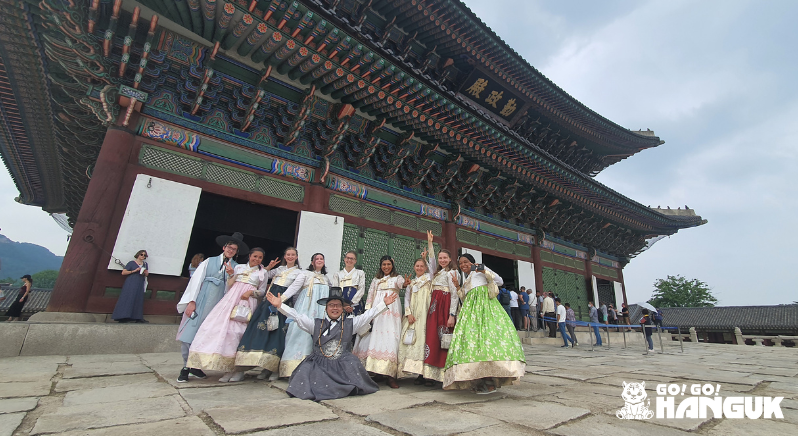
Study trip options for studying in Korea
Another alternative of the available options for studying in Korea will be our “Study trip” program. Go! Go! Hanguk study trips are 2-3 week all-inclusive packages which include studying at a Korean language school, accommodation, and cultural activities.
We offer a wide range of organised trips that combine language study with travel. Cultural activities are both traditional and modern, ranging from the oldest aspects of South Korea to modern elements like K-pop.
Choose the study vacation that is right for you from our Korea Study trips page, book your flights, and we will take care of the rest!
Pros
- Quick and easy enrollment
- Customizable packages
- Enjoy cultural activities and language study on site
- Meet people from all over the world
Cons
- Less flexibility than making your own travel arrangements
- Not enough time to hone your skills in Korean
Read this article of ours on the benefits of participating in a Study trip to Korea.
FAQ
1. What is the main difference between the D-4 visa and an H-1 Working Holiday visa?
The D-4 visa is designed for long-term university language courses (6 to 24 months) and permits part-time work only after your first 6 months. In contrast, the H-1 Working Holiday visa allows you to work immediately for up to 25 hours per week while traveling or taking short courses. However, the H-1 visa is restricted to applicants aged 18–30 and cannot be converted to another visa type once in Korea.
2. Can I work part-time if I choose a short-term study option on a tourist visa?
No, studying on a visa-free tourist stay (up to 90 days) does not permit any part-time work in Korea. If your plan is to work in Korea, you should consider applying for a Working holiday visa.
3. What is included in a Go! Go! Hanguk Study Trip?
Go! Go! Hanguk Study Trips are 2- to 3-week all-inclusive packages that combine Korean language classes with pre-arranged accommodation. They also include organized cultural activities ranging from traditional heritage visits to modern K-pop experiences.
4. How far in advance should I apply for a long-term D-4 student visa?
You should begin the application process at least 6 months in advance to ensure enough time to gather all required documentation.
Go! Go! Hanguk can help you study in Korea
Go! Go! Hanguk has a team of study abroad experts who have been helping people live and study in Korea for years. We offer 100% free support in finding the right school and accommodation, while guiding you through the entire application process to move to Korea.
Whether you want to move to Korea or take a short study vacation with our Study trips, it is always better to plan ahead and contact us as early as you can! For those who need the D-4 student visa, we recommend contacting us at least six months in advance to make sure you can get your documentation together and complete your registration in time.
If you want to learn more about life in Korea, check out our other blog articles with updates. If you want to live and study in Korea, contact us for more information!