Skip to content



Knowing how to apologize at the right time is an important quality in everyday life. In a society such as Korea, where it is essential to demonstrate one’s ability to stand in one’s hierarchical role, apologizing and knowing how to do it in the right way is an essential requirement. Depending on the situation, there are different ways to apologize in Korean, some more formal and some less so.
In this guide, we’ll look at five common Korean expressions and gestures you should know.
What are the most common ways to apologize in Korean?
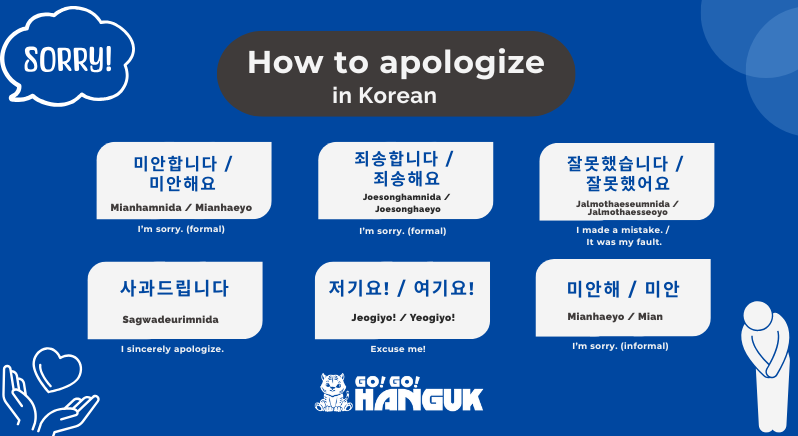
Saying “sorry” in Korean isn’t just about translating a single word—it’s about matching your tone to the person you’re speaking to. To help you navigate these nuances effortlessly, we’ve put together a quick breakdown of the most essential phrases:
| Hangul | Transliteration | English | When to use |
| 미안 | Mian | Sorry | Very casual; minor situations |
| 미안해 | Mianhae | Sorry | Casual; friends or people you’re close to |
| 미안해요 | Mianhaeyo | Sorry | Polite; everyday situations |
| 미안합니다 | Mianhamnida | I’m sorry | Formal situations |
| 죄송해요 | Joesonghaeyo | I’m sorry | Polite; more respectful/formal |
| 죄송합니다 | Joesonghamnida | I’m sorry | Very polite/formal situations |
| 잘못했어요 | Jalmothaesseoyo | I made a mistake | Polite; everyday situations |
| 잘못했습니다 | Jalmothaetseumnida | I made a mistake | Formal situations |
| 사과드립니다 | Sagwadeurimnida | I sincerely apologize | Very formal/professional situations |
| 저기요 | Jeogiyo | Excuse me | Getting someone’s attention |
| 여기요 | Yeogiyo | Excuse me / Over here | Getting someone’s attention, especially staff |
How do you apologize to friends in Korean?
Sometimes even among friends, if you do not have a very close bond, it may happen that you still speak in jondaetmal (존댓말) and not in banmal (반말), that is, in semi-formal language, with the -yo (-요) as a final ending, and not in informal, colloquial language. Therefore, depending on the language you usually use with each other, you will have to choose the most appropriate expression to apologize in Korean.
The most commonly used verb to apologize in Korean is mianhada (미안하다), which becomes mianhaeyo (미안해요) in jondaetmal and mianhae (미안해) in banmal. You can use this verb to apologize for something you did or to express displeasure. Also, if the reason you are apologizing is not something too serious, you can abbreviate and simply say mian (미안). So if, for example, you were ten minutes late for an appointment, “mian” is the appropriate expression, whereas for something more serious using simply “mian” might sound shallow and only make the situation worse.
In summary, to politely apologize to friends, you can use:
미안해요
Mianhaeyo
Sorry (more polite, to be used if you have not yet dropped the formalities)
Or:
미안해
Mianhae
Sorry (more informal)
For more informal apology, you can also choose to further shorten the expression to:
미안
Mian
Sorry (for minor situations)
How do you apologize formally in Korean?
In more formal contexts, such as at work or interacting with more hierarchically important people (simply older people, since age is a very important factor in Korea), two verbs are mainly used. One is again the one mentioned above, which is mianhada. The other is joesonghada (죄송하다), which itself already has a more formal and unofficial meaning and therefore cannot be used in banmal. These two verbs can be conjugated with the form in –seumnida (-습니다) or with the form in –yo (-요), thus becoming respectively:
미안합니다 / 미안해요 / 죄송합니다 / 죄송해요
Mianhamnida / Mianhaeyo / Joesonghamnida / Joesonghaeyo
Sorry / Excuse me
Accompanying the words of apology with a small bow will make it more effective to apologize in Korean.
How do you apologize when you admit a mistake?
Did you know that besides mianhamnida & joesonghamnida, there are also 2 other phrases commonly used to apologize in Korean? Sometimes you can say 잘못했어요 (jalmothaesseoyo), or add –seumnida (습니다) to make it formal. You can use it in everyday situations, like if you’re late to meet a friend, accidentally break something, or make a small mistake at school or work. It’s polite but still feels natural and friendly, making it perfect for casual settings where you want to show you’re sorry without sounding too formal.
잘못했습니다 / 잘못했어요
Jalmothaeseumnida / Jalmothaesseoyo
I made a mistake / It was my fault
Meanwhile, sagwadeurimnida (사과드립니다) is a much more formal way to apologize in Korean. It is used when you need to show a high level of respect. You’ll hear it in professional environments, formal announcements, customer service situations, or whenever the mistake is serious. Using sagwadeurimnida shows that you’re taking responsibility seriously and that you respect the other person.
사과드립니다
Sagwadeurimnida
I sincerely apologize
Fun fact: 사과 (sagwa) also means apple! Check out this quick reel to hear how to pronounce sagwa!
How do you say “excuse me” to get someone’s attention in Korean?
In Korea, to stop someone on the street and ask them for directions or to attract the attention of a waiter at a restaurant, we usually use jeogiyo (저기요). This expression is precisely used to attract attention and always ends with the formal ending –yo. A variant of jeogiyo is yeogiyo (여기요). The difference between the two words is very subtle and they are practically interchangeable with each other. Literally, we could translate the two terms as “hey there” and “here,” with a more polite tone.
저기요! / 여기요!
Jeogiyo! / Yeogiyo!
Sorry! (to attract attention)
What gestures are used when apologizing in Korea?
When in Rome, do as the Romans do. Just as in Korea, we have gestures to accompany the right situations. As we mentioned just above, it is customary to accompany words of apology with a bow. The common Korean desperate plea for forgiveness is to join hands and rub them together quickly, always accompanying the gesture with words of apology. If you watch Korean dramas, you have probably already seen a similar scene, in which perhaps the character in question even throws himself down on his knees to increase the sincerity of the situation.
These are the most commonly used ways to apologize in Korean. However, if you are not sure which expression to use, we recommend mianhaeyo, which is the most neutral and common form.
If you wish to find out more about living and studying in Korea, be sure to contact us or keep updated on our Go! Go! Hanguk blog for more content.